Open-source application
The Rails application is the reusable workshop platform. Fork it, adapt its workflows, and use it as a starting point for your own learning programme.

An open-source workshop platform
IMASUS is a public archive and an open-source platform for designing participatory learning experiences around complex sustainability challenges.
Built to be reused
The Rails application is the reusable workshop platform. Fork it, adapt its workflows, and use it as a starting point for your own learning programme.
Combine workshops, published projects, a materials library, training modules, challenge cards and a glossary in one durable public site.
The structure supports different contexts: educational programmes, community innovation labs, research initiatives, and cross-sector collaborations.
The IMASUS experience
IMASUS brought together young textile professionals, educators, researchers and partners to learn by working on real industry questions. It connects material knowledge with systems thinking, creative practice, and collaborative action.
Prato, Italy — Lottozero
A 2-day hands-on workshop in Prato dedicated to fashion design for recyclability. Hosted in collaboration with fashion designer Eva Di Franco, the workshop combines textile innovat…
Explore this workshopZaragoza, Spain
Un taller IMASUS en Zaragoza que combina una sesion de webinar con una jornada presencial para explorar materiales sostenibles, retos de la industria textil y propuestas colectivas…
Explore this workshopRomantso hub (Anaxagora 3-5, Athens, Greece)
This workshop adapts the IMASUS Imagineering methodology to the Greek context, combining ancient craftsmanship and textile wisdom with contemporary sustainability strategies. Parti…
Explore this workshopLearn more about the wider initiative at imasus.eu.
Published outcomes
A selection of proposals developed by IMASUS participants through the workshops.
The Imagineering framework
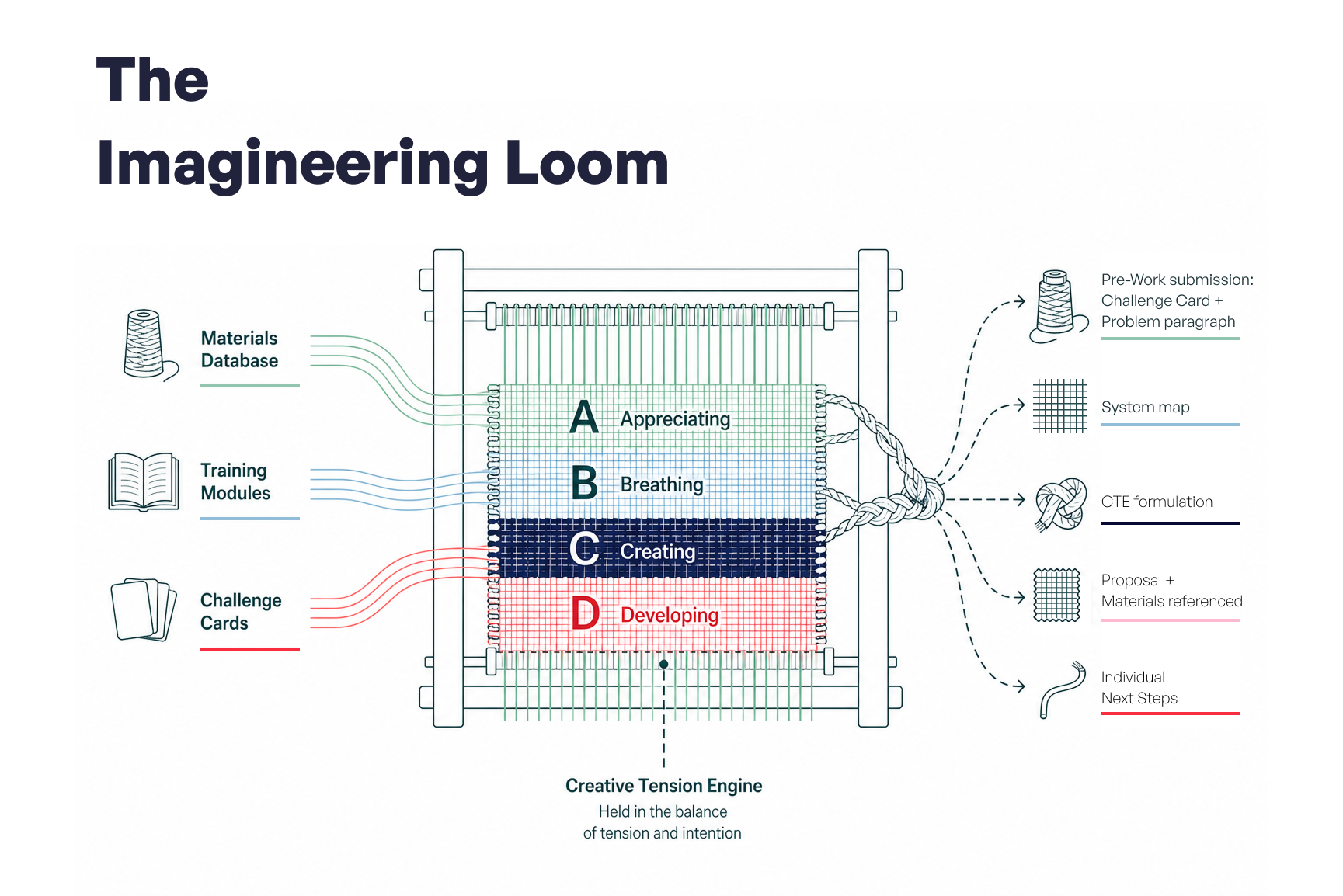
The Imagineering Loom connects materials, training, challenge cards and collective reflection through four spaces: Appreciating, Breathing, Creating and Developing.
Explore the platform
Materials
Sustainable textiles, fibres and finishes with images and properties.
Training
Modules, cases and toolkits in four languages.
Challenges
Questions that help teams frame and focus their work.
Glossary
Terms spanning materials, design, industry and methodology.
Make it yours
The Rails application is open for study and adaptation; this archive shows how a completed educational programme can remain publicly useful after its workshops end.